
How to Reach the San Luis Obispo County Court Clerk
The main court clerk counter sits at 1050 Monterey Street, Room 220, in downtown San Luis Obispo. Civil, family, probate, and criminal cases all file through this address. One phone line covers all three branches. Court staff answer that line Monday through Friday from 8:30 AM to noon. The counter itself is open Monday through Thursday in the same morning window. Paso Robles also opens on Friday for civil and family matters.
Mail goes to a different door. Copy requests, written orders, and other paper sent by mail belong at the Courthouse Annex on Palm Street. Court Administration takes mail there and routes it to the right division. Drop boxes at the courthouse entrances catch a few filing types after hours, but counter staff still review what comes in the next morning.
Civil & Family Law Branch / Criminal Branch
Court Executive Officer / Clerk: Michael Powell
1050 Monterey Street, Room 220
San Luis Obispo, CA 93408
(805) 706-3600
Counter: Mon-Thu 8:30 AM-noon
Phones: Mon-Fri 8:30 AM-noon
Court Administration / Mail Copy Requests
Courthouse Annex
1035 Palm Street, Room 385
San Luis Obispo, CA 93408
(805) 706-3600
Mail Copy Request Forms here
Make checks payable to "Superior Court"
The San Luis Obispo County Court Executive Officer Role
California does not use the Texas "district clerk" title. Trial court records sit with the Superior Court itself, and the office is led by a Court Executive Officer who also serves as Clerk of the Superior Court. Michael Powell holds that post in San Luis Obispo County. He works under the direction of the Presiding Judge, Hon. Tana Coates, and the Assistant Presiding Judge, Hon. Jesse Marino. The court has thirteen judges and two commissioners.
The role is broad. The Court Executive Officer hires court staff, runs the budget, oversees filings, and reports to the bench on day to day work. Clerks at the public counter act on his authority when they accept papers, set fees, and stamp orders. None of these jobs touch deeds, voter rolls, or marriage licenses. Those duties sit with a separate elected officer covered below.
Filing and Drop Boxes at the Court Clerk
Most case starts begin at the Civil & Family Law Branch counter. Paper filers wait in line. E-filers send through an approved vendor and skip the line for many civil and probate matters. The court clerk reviews each filing for the right form, the right fee, and the right caption before it gets a case number. Rejected paper goes back with a note. After a case is open, later filings can use the same counter, e-filing, fax with leave, or a drop box.
- Drop boxes sit at the entrances of court branches for some filings outside counter hours.
- Time-sensitive items, like ex parte papers, should still go to the counter when staff is on duty.
- Court does not provide court reporters in civil matters. Parties must hire a private reporter.
- Family Court Services handles mediation intake from Room 224 at 1050 Monterey Street.
- Civil fee schedules and bail schedules are posted on the court website.
The court runs Online Case Lookup notices for known issues. A current notice warns that some cases may be missing data in the public portal. The clerk's office takes calls about gaps and can pull paper files when remote data does not match what was filed.
San Luis Obispo County Clerk Case Copies and Certifications
Anyone can ask for a plain or certified copy from the court file in most case types. Some case types have access limits, like sealed juvenile or confidential family matters. The clerk first checks the case number, then pulls the file or the digital image, then prints. Plain copies print at fifty cents per page. Certified copies cost the per page fee plus a flat certification charge for each document.
Many people need a certified copy of a divorce judgment, a custody order, a name change order, or a small claims ruling. Banks, schools, and government agencies often want the raised seal or the court stamp before they act. The clerk seals and signs each certified copy, then dates it. Court records from older cases may need staff search time before they can be copied.
re:SearchCA Access for San Luis Obispo County Court Records
San Luis Obispo Superior Court launched re:SearchCA on January 4, 2024. It was the first county in California to roll out the Tyler Technologies platform. The portal lets the public search case data from the court's case management system. Remote use needs a free account. Courthouse kiosks at all branches do not need an account and give wider document access than the home log in.
Attorneys use a separate Attorney Portal. Counsel of record must request access and verify bar information. The court usually grants access within one business day. Some case types and documents remain limited under California Rule of Court 2.503. Criminal, family law, and domestic violence documents are often kiosk only.
Source: re:SearchCA portal and Attorney Portal.
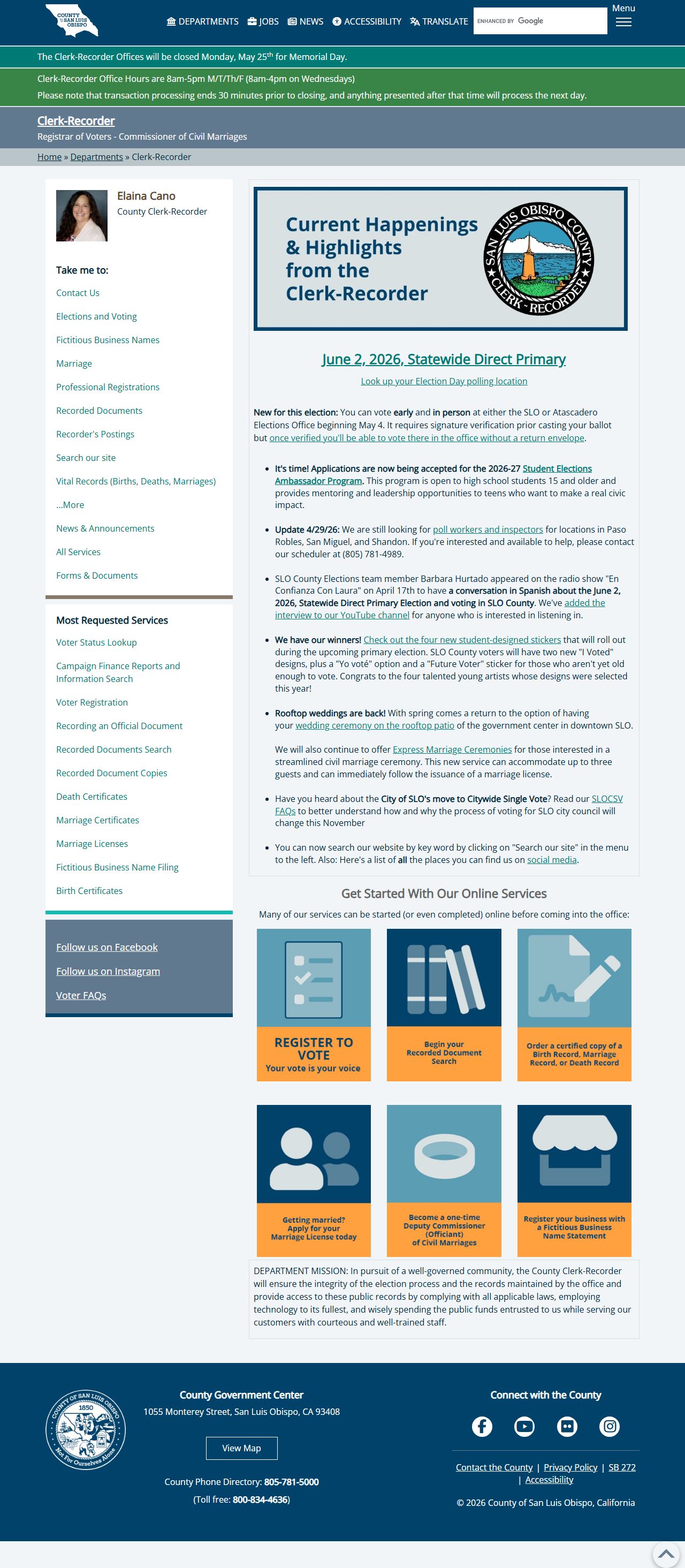
The image above shows the County Clerk-Recorder homepage, the office often confused with the court clerk. Court case files do not live there. They live with the Superior Court at 1050 Monterey Street.
How to Request a Certified Copy from the Court Clerk
A certified copy proves that a document is a true copy of what the court holds. Use the steps below for civil, family, probate, small claims, or criminal case copies. Plain copies follow the same path without the certification line.
- Find the case number. Look at filed papers, ask a party, or use a courthouse kiosk. The court self-help page on getting copies of court files walks through this step for appeal users.
- Fill out the court Copy Request Form. List the case number, party names, document title, number of copies, and whether each copy needs certification.
- Submit in person at 1050 Monterey Street, Room 220, or by mail to Court Administration at 1035 Palm Street, Room 385. Include payment and a stamped self-addressed envelope for mail requests.
- Pay copy and certification fees. Mail filers should write a "not to exceed" amount on the check, made payable to "Superior Court."
- Wait. In-person copies come back the same day when files are not in storage. Mail copies take longer. Call (805) 706-3600 to check status.
Court Clerk Copy Request Form Fields
The court clerk needs enough detail to pull the right paper. Missing fields slow the work and may push a request past the ten minute search rule. The table lists the fields used on the court's Copy Request Form along with notes.
| Field | Required | Notes |
|---|---|---|
| Case Number | Yes | Get from filed papers or a kiosk lookup. Speeds the search and lowers the chance of a research fee. |
| Party Names | Yes | Plaintiff and defendant, or petitioner and respondent. Spelled the way the case was filed. |
| Document Title | Yes | Name of the order, judgment, minute order, or filing being copied. |
| Filing Date | If known | Helps clerks find the right document in long case files. |
| Number of Copies | Yes | Each copy is billed per page. Certified copies add a flat fee per copy. |
| Certified or Plain | Yes | Certified copies carry the court's seal and stamp. |
| Requester Name and Address | Yes | Used for mailing copies and refunds. |
| Daytime Phone | Yes | Clerks call when a request is unclear or a fee is short. |
| Payment | Yes | Cash or card at the counter. Check or money order by mail, payable to "Superior Court." |
| Self-Addressed Stamped Envelope | Mail only | Required for mail-back delivery. |
San Luis Obispo County Court Clerk Fee Schedule
Copy and search fees are set by state law. The court posts current civil fees and bail schedules on its fee and bail schedule page. Filing fees for new cases run higher and depend on case type and amount in controversy.
| Item | Amount |
|---|---|
| Plain copy per page | $0.50 |
| Certified copy per page | $0.50 |
| Certification fee per document | $40.00 |
| Research fee (staff search over 10 minutes) | $15.00 (Gov. Code § 70627(c)) |
| Civil case filing fees | State schedule, see linked page |
| Bail amounts | State and local bail schedule, see linked page |
The court does not waive copy fees by default. Fee waiver applicants must file Form FW-001 and meet income limits. The court clerk can hand out the form and answer general questions, but staff cannot give legal advice.
San Luis Obispo County Court Clerk Branch Counters
Three branches share one phone line and one court clerk's office. Each branch takes filings and offers a kiosk. Hours and roles vary a little by site.
San Luis Obispo (main)
1050 Monterey Street, Room 220
San Luis Obispo, CA 93408
(805) 706-3600
Counter: Mon-Thu 8:30 AM-noon
Paso Robles Branch
901 Park Street
Paso Robles, CA 93446
(805) 706-3600
Counter: Mon-Thu 8:30 AM-noon
Civil/Family also Fri 8:30 AM-noon
Grover Beach Branch
214 South 16th Street
Grover Beach, CA 93433
(805) 706-3600
South county branch
Each location has concurrent county-wide jurisdiction under Local Rule 2.03, and the San Luis Obispo location is the administrative headquarters. Superior court hearings move between branches based on case type and judge assignment.
Court Clerk vs County Clerk-Recorder in San Luis Obispo County
People often mix up the court clerk and the County Clerk-Recorder. They are two different offices with two different bosses and two different missions. The court clerk works for the Superior Court. The Clerk-Recorder is a separate elected county officer. Elaina Cano holds the Clerk-Recorder post in San Luis Obispo County.
Source: slocounty.ca.gov Clerk-Recorder.
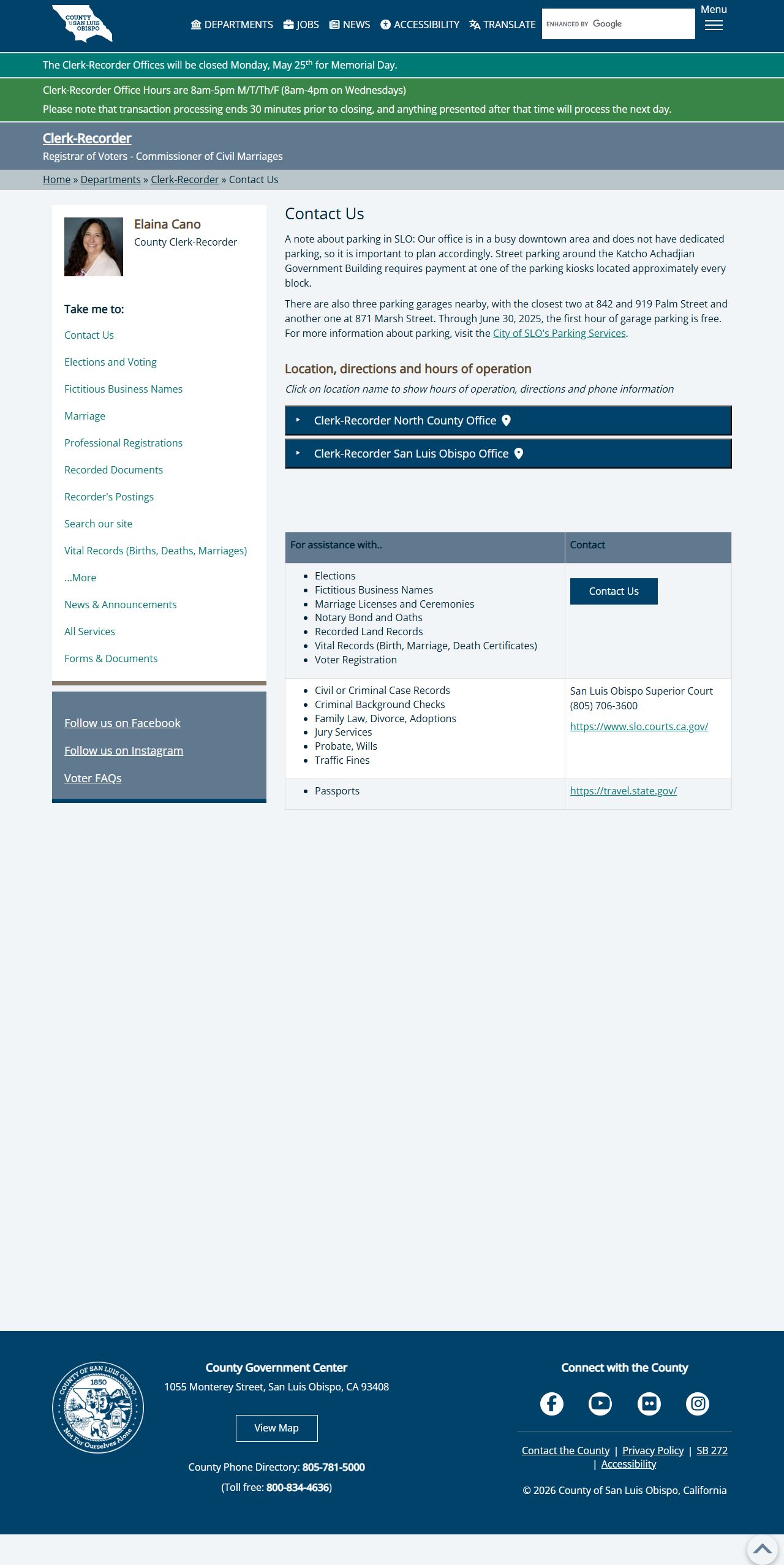
The Clerk-Recorder contact page itself tells visitors that court case files belong with the Superior Court. The two offices share a street but not a job list.
| Office | Holds | Address |
|---|---|---|
| Clerk of the Superior Court (court clerk) | Court case files, civil, family, probate, criminal, traffic, small claims, certified court orders | 1050 Monterey Street, Room 220, San Luis Obispo |
| County Clerk-Recorder | Recorded deeds, birth/death/marriage certificates, marriage licenses, fictitious business names, voter rolls | 1055 Monterey Street, Suite D120, San Luis Obispo |
For deeds and other land records, plus vital records, see the Clerk-Recorder. For divorce decrees and other court orders, see the court clerk. The marriage and divorce records page lays out which office to use for each kind of record. For wider county records, the public records page covers the California Public Records Act path.
San Luis Obispo County Court Family Court Services
Family Court Services helps parties in custody, visitation, and parenting plan cases. The unit sits in Room 224 at 1050 Monterey Street, one door down from the main court clerk counter. The phone number is (805) 706-3608. Mediators meet with parents before custody hearings and may file a written recommendation with the court clerk.
The court clerk handles the case file itself. Family Court Services handles the meeting. Both touch the same case. Parents get notice from the court clerk about the date and time of mediation. Many family law forms can be filed by mail to Court Administration or e-filed through an approved vendor.