
Court Records Basics
How do I look up a San Luis Obispo County court case online?
Start at the Superior Court's Online Case Lookup page and follow the re:SearchCA link. Remote access needs a free account or an eFileCalifornia sign-in. The court also offers courthouse kiosks that do not need a login. Some criminal, family law, and domestic violence files are limited to courthouse access under state court rules. A case may show online while the documents are kiosk-only. For a full walk-through, see our court records guide, and check court dockets for hearing calendars.
Does San Luis Obispo County have a district clerk?
No. California does not use a Texas-style district clerk. Case files are held by the Superior Court clerk, also called the Court Executive Officer. The County Clerk-Recorder is a separate office. It handles recorded land documents, marriage licenses, vital records, elections, and fictitious business names. For divorce, criminal, civil, probate, and docket files, start with Superior Court. For more on the split, see the Clerk of the Superior Court page and the Superior Court overview.
What are the main court addresses?
The Civil and Family Law Branch and the Criminal Branch share 1050 Monterey Street, Room 220, San Luis Obispo, CA 93408. The general phone is (805) 706-3600. The Grover Beach Branch is 214 South 16th Street. The Paso Robles Branch is 901 Park Street. Court copy mail goes to 1035 Palm Street, Room 385. Each location has county-wide jurisdiction. See the Superior Court page for branch hours and the court records page for the full record process.
Searching Online and Getting Copies
How do I get copies of court files?
Find the case number first. You can use a public computer at the court to look it up. Then ask for copies at the court counter or by mail. Mail requests go to Superior Court, 1035 Palm Street, Room 385, San Luis Obispo, CA 93408. Plain copies are $0.50 per page. A $15 research fee applies if the search takes more than ten minutes. Send a stamped self-addressed envelope for mail returns. The court records page has the full copy request form details.
Are all court documents available remotely?
No. California Rule of Court 2.503 limits remote public access to many electronic files. The court's re:SearchCA release notes that access depends on the user's role. Criminal, family law, and domestic violence documents have courthouse-only access limits. If a remote search looks thin, use a courthouse kiosk to check the same case. For a deeper view of access rules, see our public records page and the court dockets page for hearing data.
How do I get a traffic ticket lookup or pay a fine?
The Superior Court lists "Pay a Traffic Ticket" under Online Services. You can search by citation number, or by last name plus date of birth. Pay online with a credit card, in person at the Criminal Branch counter, or by mail to 1035 Palm Street, Room 385. Online payment gives you an instant receipt. For trial by written declaration and traffic school steps, see the full traffic court records guide.
Inmate and Jail Questions
How do I find an inmate in San Luis Obispo County Jail?
Use the Sheriff's "Who's in Custody" page. The form has First Name and Last Name fields and a Search button. Results show the inmate ID, booking number, name, gender, date of birth, age, booking date, projected release, bail, charges, and arresting agency. Each result has a VINE link. Do not use the search for legal action. Call the jail at (805) 781-4600 to verify. For the full field list and search tips, see inmate records.
Does the jail publish released inmates?
No separate released-inmate list was found. For an adult who was booked but is no longer in custody, call the Records Department at (805) 781-4588. To check release timing for someone still in custody, call (805) 781-4600. The Sheriff also runs a booking log that covers the last 30 days. That log is the best public record for recent releases. See our released inmates page for the steps and phone tree.
When are inmates released?
The Sheriff FAQ says scheduled releases for inmates who served their time run between 7:30 AM and 9:00 AM. Short stays of three days or less are released at exact 24, 48, or 72 hours from check-in. Court-ordered releases depend on paperwork moving through the jail. They can take several hours to clear. Plan pickup windows around those rules. For more on jail timing and population data, see inmate population.
How do I put money on an inmate's account?
Use TouchPay Direct online or by phone after you register. You can also use the TouchPay kiosk in the jail lobby. The facility number is 293405. Funds usually post within 24 hours. Fees are $2.95 for deposits up to $200 and $3.95 for deposits over $200. iCare and Aramark can be used for pre-packaged commissary items. The inmate records page lists current fees and contact numbers for the jail.
How do I schedule jail visits?
Since April 7, 2025, all on-site visits must be booked through NCIC at videovisit.ncic.com. Appointments must be set no more than 7 days out and no less than 48 hours out. Check in 45 minutes early. The Sheriff recommends 60 minutes. Inmates get two one-hour on-site visits per week. Video visits use the NCIC Mobile app or a computer with camera and mic.
The image below shows the NCIC sign-up flow at account.ncic.com. 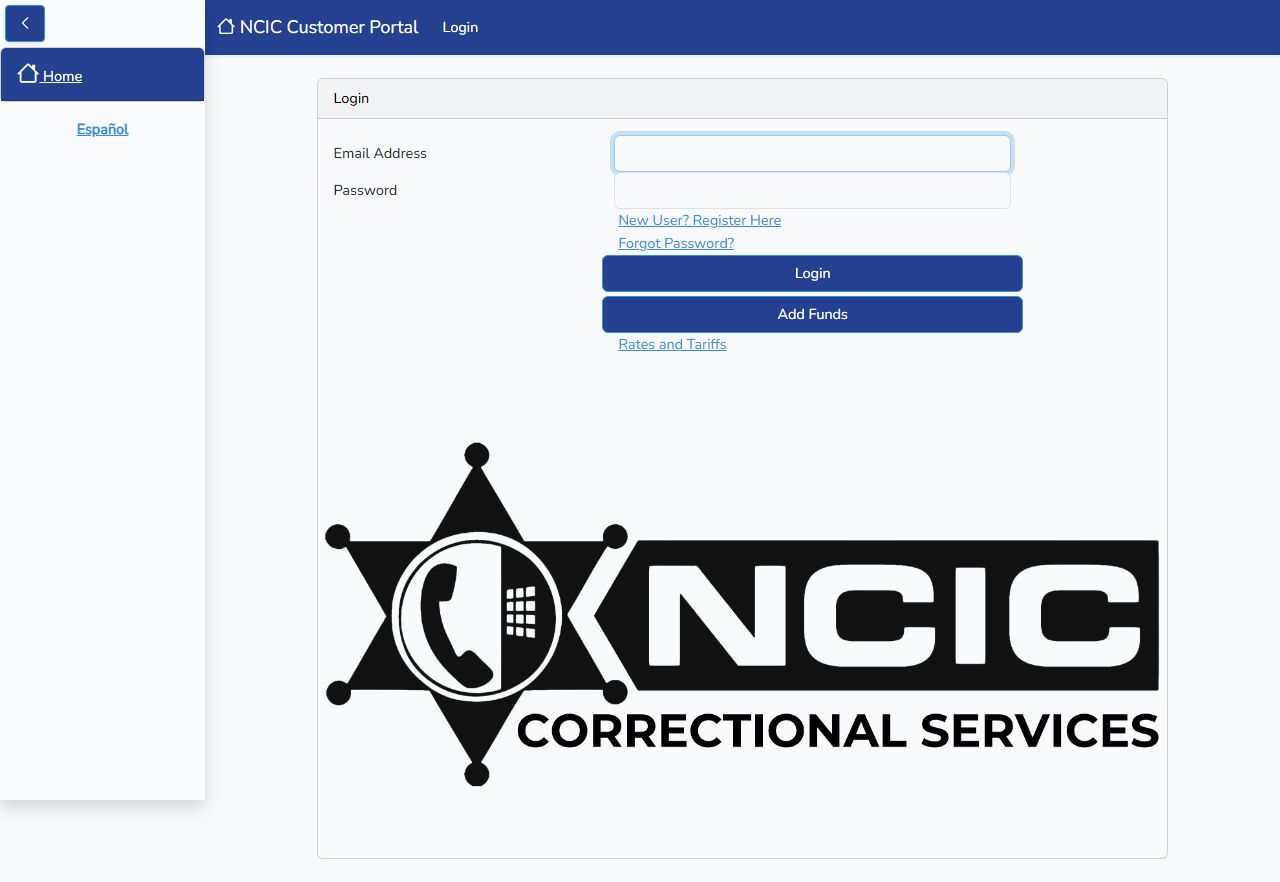 See account.ncic.com/Registration to start. The video portal itself is at videovisit.ncic.com; its homepage is shown below.
 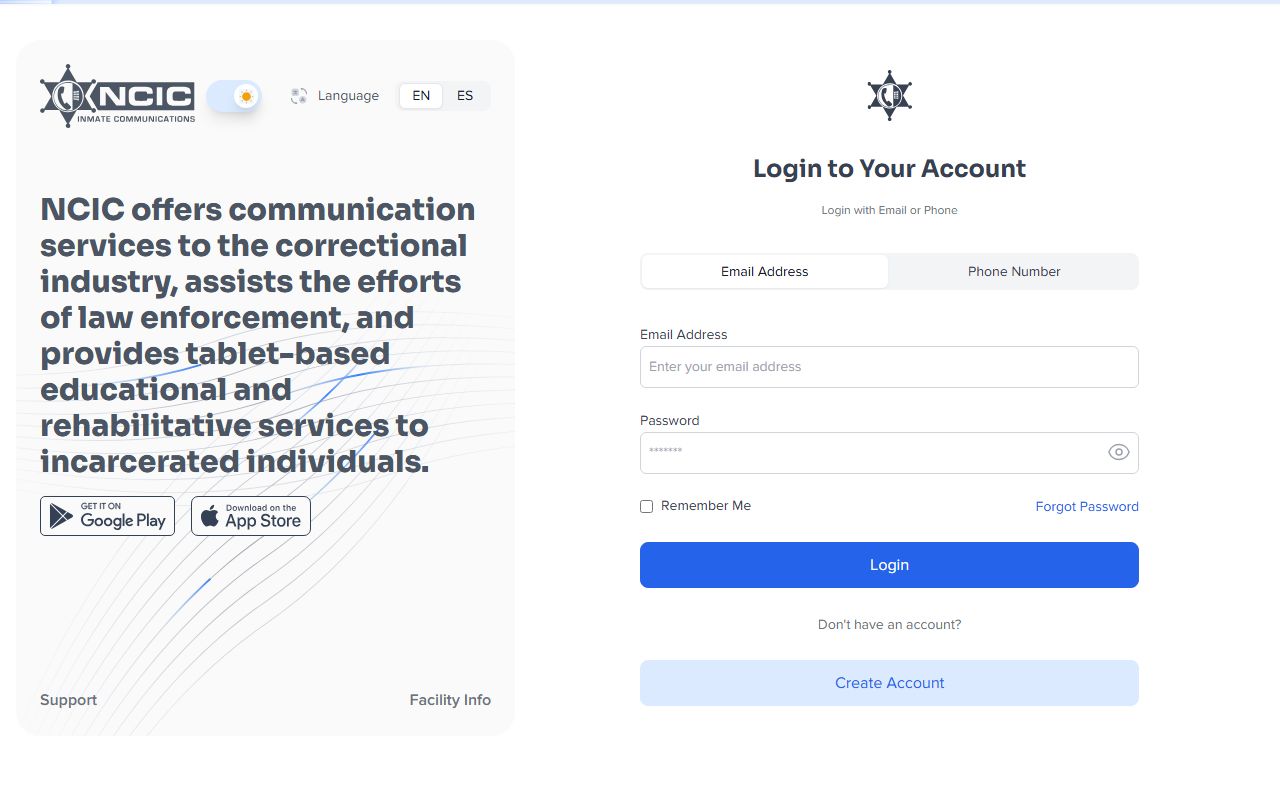 Video visitation is listed at $0.19 per minute. For more on jail rules, see inmate records.
Warrants and Resolution
How do I find out if I have a warrant?
Call the Sheriff Records and Warrants Unit at (805) 781-4588. The Sheriff says limited adult warrant info is generally available by phone. That includes the charges, the bail amount, and the issuing agency. If you doubt whether a warrant should exist, also contact the Superior Court at (805) 706-3600. There is no public online active-warrant search. A clean online search does not prove that no warrant is out. See warrant records for the full process.
How do I resolve a warrant?
Most warrants can be handled three ways. You can work with a bail bondsman, surrender at the Sheriff's Office, or contact the court that issued the warrant. Do not assume that an online absence means no warrant. There is no county active-warrant search. Confirm by phone first. Many people speak with a lawyer before they surrender. Our warrant records page walks through each option. For criminal case files, see criminal records.
How do I request a crime or arrest report?
Contact the Sheriff Records Unit at (805) 781-4140. The Sheriff says there is no fee for a basic report. Most requests are processed within 10 business days. Reports may be redacted under state law. Adult arrest info for arrests made by the Sheriff's Office can also be requested from the same unit. A statewide rap sheet must come from the California DOJ, not the county. See criminal records for the full path and public records for CPRA basics.
Marriage, Divorce, and Probate
Where do I get a marriage license?
Go to the County Clerk-Recorder at 1055 Monterey Street, Suite D120, San Luis Obispo. You may start online through the self-service portal or use the in-office kiosk. Both parties must appear in person with valid ID. A license is good for 90 days. It can be used anywhere in California. Marriage records held by the Clerk-Recorder are not searchable online. See marriage and divorce records for the steps, fees, and the public vs. confidential license split.
Where do I get divorce records?
Divorce files are Superior Court family case records. The Clerk-Recorder does not hold them. Use re:SearchCA for public case info. Use courthouse kiosks where enhanced access is allowed. Use a court copy request for documents. Family files may have remote access limits and redactions for safety. Mediation questions go to Family Court Services at (805) 706-3608. The marriage and divorce records page lays out start, respond, and finish steps.
Where are probate cases filed?
All probate matters are filed and heard at the Civil and Family Law Branch, 1050 Monterey Street, Room 220, San Luis Obispo. Probate covers estates, trusts, guardianships, and conservatorships. The Petition for Probate fee is listed as $435. Will lodging after death is $50. New probate cases get a hearing roughly four to five weeks out. Other judge requests can take 10 to 12 weeks. See probate records for forms, notes, and the small-estate path.
What are probate notes?
Probate notes are tentative rulings for cases set for hearing. The court aims to post a first version about a week before the hearing. It updates the notes the day before the hearing as filings come in. Notes can change, so check often. They are reached from the court's Probate page. Notes help self-represented parties spot defects before the hearing. The probate records page has links and the tentative ruling workflow.
Public Records, Help, and Practical Tips
Who provides public defender services?
San Luis Obispo County contracts public defense services. San Luis Obispo Defenders is the primary public defender contractor. The phone is (805) 541-5715. Conflict and secondary conflict firms are also used. The county may reimburse appointed private counsel where conflicts exist. The court does not assign counsel by phone. The judge appoints counsel at the first hearing. See criminal records for the criminal case path and contact list.
Who do crime victims contact?
The District Attorney's Victim/Witness Assistance Center is at 1035 Palm Street, 4th Floor, San Luis Obispo. Phone (805) 781-5821 or the hotline at 866-781-5821. Email is da.contactus@co.slo.ca.us. Services include court orientation, restitution help, case notifications, and CalVCB claim support. The image below shows the official page. 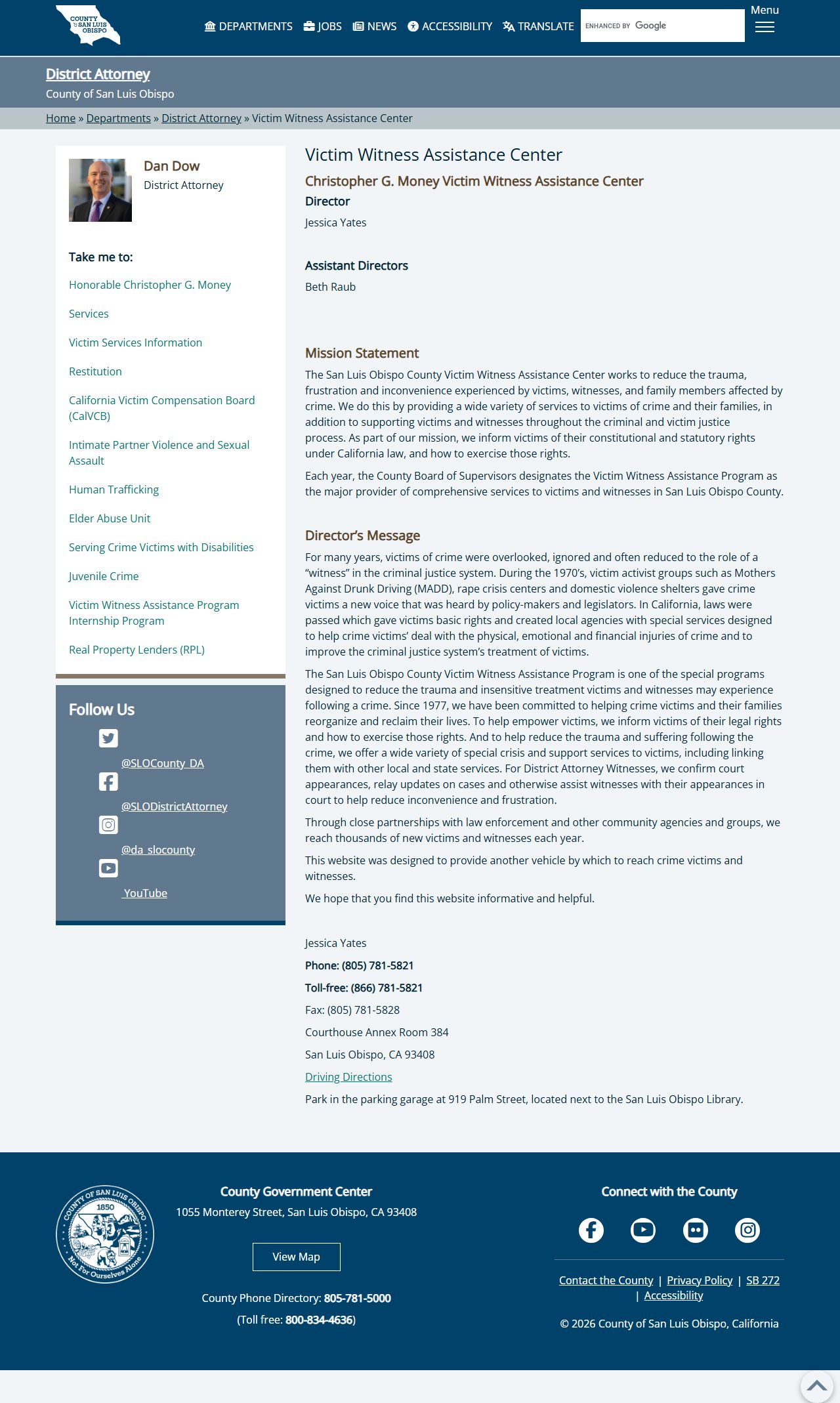 See the Victim/Witness Assistance Center for full services.
Where should I park for court?
Use the City of San Luis Obispo garages near downtown. City garages include 842 Palm, 919 Palm, 871 Marsh, and 609 Palm. Posted garage rates are $2 per hour with an $8 daily max. On-street parking in core zones costs more and is time limited. Thursday evening Farmers' Market closes Higuera Street at 5 PM. Late hearings should plan around that. For court-side updates, see the Sheriff news archive and the Superior Court page.
Still Have Questions?
For the right office, see Clerk of the Superior Court. For broader access rules, see public records. For records by topic, browse court records, criminal records, inmate records, warrant records, marriage and divorce, or probate.