
San Luis Obispo County Public Records and the CPRA
The California Public Records Act controls most agency files. It was recodified into Government Code Division 10. The new section numbers took effect on January 1, 2023. The short title is set by Gov. Code § 7920.000. Source URL: leginfo.legislature.ca.gov. The screenshot below shows the official text page for the short title section. 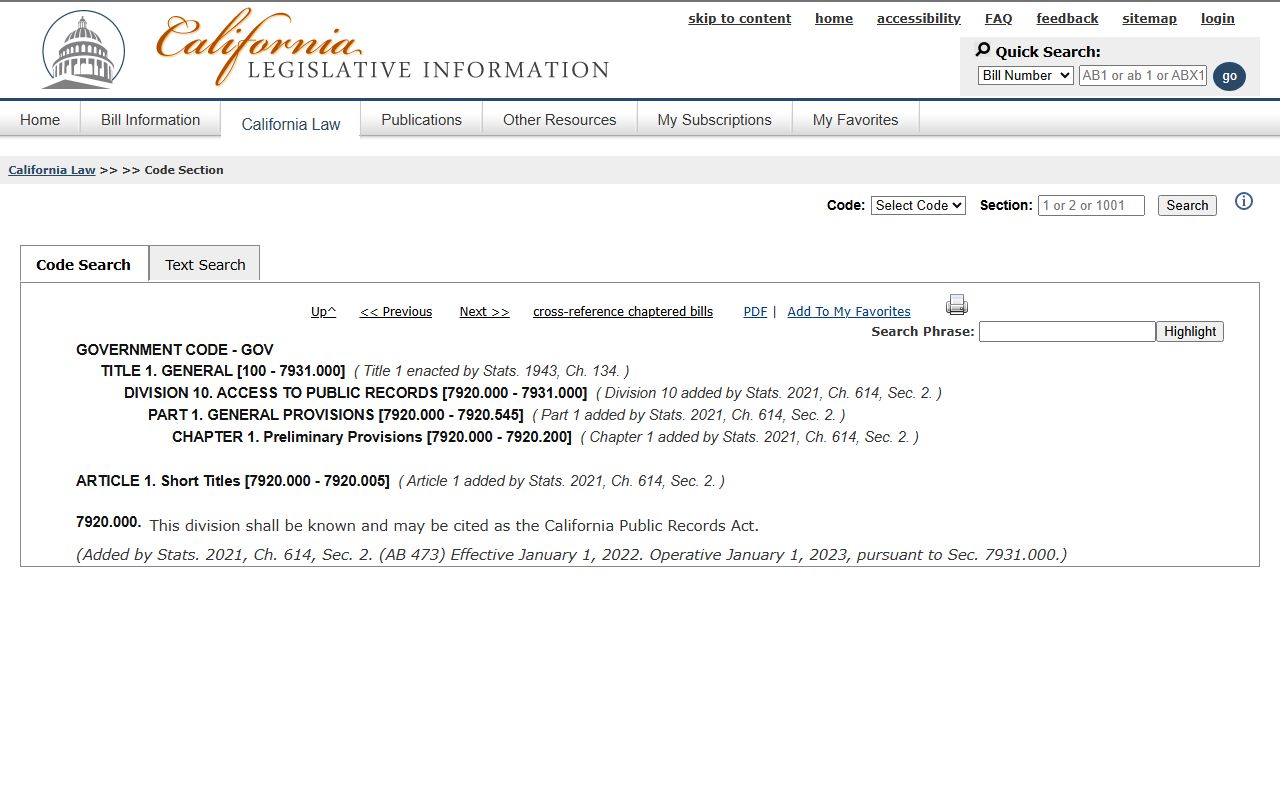 The same legislative site holds every other CPRA section a requester might need.
The CPRA covers files held by San Luis Obispo County offices. It does not cover court case records. Court files are handled under the California Rules of Court. A San Luis Obispo County public records request may go to one office, while a court file copy goes to the Superior Court clerk. Any person can file a request. The agency cannot ask why you want the records. The agency must help you describe the records and find the right office. That duty is set by Gov. Code § 7922.600.
Court Records vs San Luis Obispo County Agency Records
The split matters. Court case files are not CPRA records. They are governed by the state constitution, common-law access rights, and California Rules of Court Title 2 (mainly CRC 2.500-2.507 and 2.550-2.551). The court itself tells users to follow its own copy procedures for case files. For a divorce file, a civil claim, or a criminal case, see the court directly. For county agency files like deeds, business filings, and sheriff reports, the CPRA applies.
If you are not sure which office holds the record, start at the San Luis Obispo County Clerk-Recorder front desk. Staff will route you. You can also see our court records page for the court side, or the Clerk of the Superior Court page for case file copies. For San Luis Obispo County arrest data, see criminal records.
How to File a San Luis Obispo County Public Records Request
You can file by mail, by email, by fax, or in person. The Clerk-Recorder has a one-page form. Other offices accept plain letters. Describe the records well. A clear request gets a fast reply. The Clerk-Recorder address is 1055 Monterey Street, Suite D120, San Luis Obispo, CA 93408. Phone (805) 781-5080. The CPRA request form for the Clerk-Recorder is online. Source URL: slocounty.ca.gov Clerk-Recorder PRA form.
- Pick the right office. The Clerk-Recorder holds deeds, vital records, marriage files, fictitious business names, and election files. The Sheriff Records Unit holds crime and incident reports. The District Attorney holds case files for cases the DA charged. The court holds court case files. Other departments hold planning, public health, and tax files.
- Describe the records. List names, dates, case or file numbers, and the type of record. A San Luis Obispo County public records request is faster when it points to a clear file. Vague requests draw delay.
- Pick a format. Say if you want paper or PDF. Say if you need certified copies. The Clerk-Recorder form has a check box for delivery method.
- Submit the request. Mail, email, or fax the form. The Clerk-Recorder fax is (805) 781-1111. You may walk in during open hours: Mon, Tue, Thu, Fri 8 AM to 5 PM, and Wed 8 AM to 4 PM.
- Wait for the first reply. The agency has 10 days to tell you if the records are disclosable. It may extend the date by up to 14 days for special cases.
- Pay any fees and get the records. Most offices charge for copies only. The Clerk-Recorder posts a full fee chart. Source URL: Clerk-Recorder fee schedule.
What San Luis Obispo County Public Records Are Public
Most county files are open by default. The CPRA names some files as not public. Everything else falls into the open set. The list below shows the main types of San Luis Obispo County public records that you can request.
- Recorded land records: deeds, deeds of trust, liens, releases, maps.
- Vital records: birth, death, and marriage records held by the Clerk-Recorder.
- Fictitious business name filings and notary bonds.
- Election files: voter rolls (with rules), filings, and campaign reports.
- Sheriff crime and incident reports, jail booking logs (subject to redaction).
- District Attorney case files for closed matters (subject to exemptions).
- Planning files, public health data, tax rolls, and other agency files.
Court case files sit outside this set. For those, see the Superior Court at 1035 Palm Street, Room 385.
Clerk-Recorder San Luis Obispo County Public Records
The Clerk-Recorder is the main point for many San Luis Obispo County public records. Director Elaina Cano runs the office. The address is 1055 Monterey Street, Suite D120, San Luis Obispo, CA 93408. Phone (805) 781-5080. Fax (805) 781-1111. The office keeps the recorded land index, vital records, marriage files, and elections data. Some indexes are online. Copies are paid for at the counter or by mail.
The Clerk-Recorder PRA form has fields for the requester, the records sought, and the way you want to get the records. The form is one page. The screenshot below shows the duty-to-assist text in the statute that the office must follow. 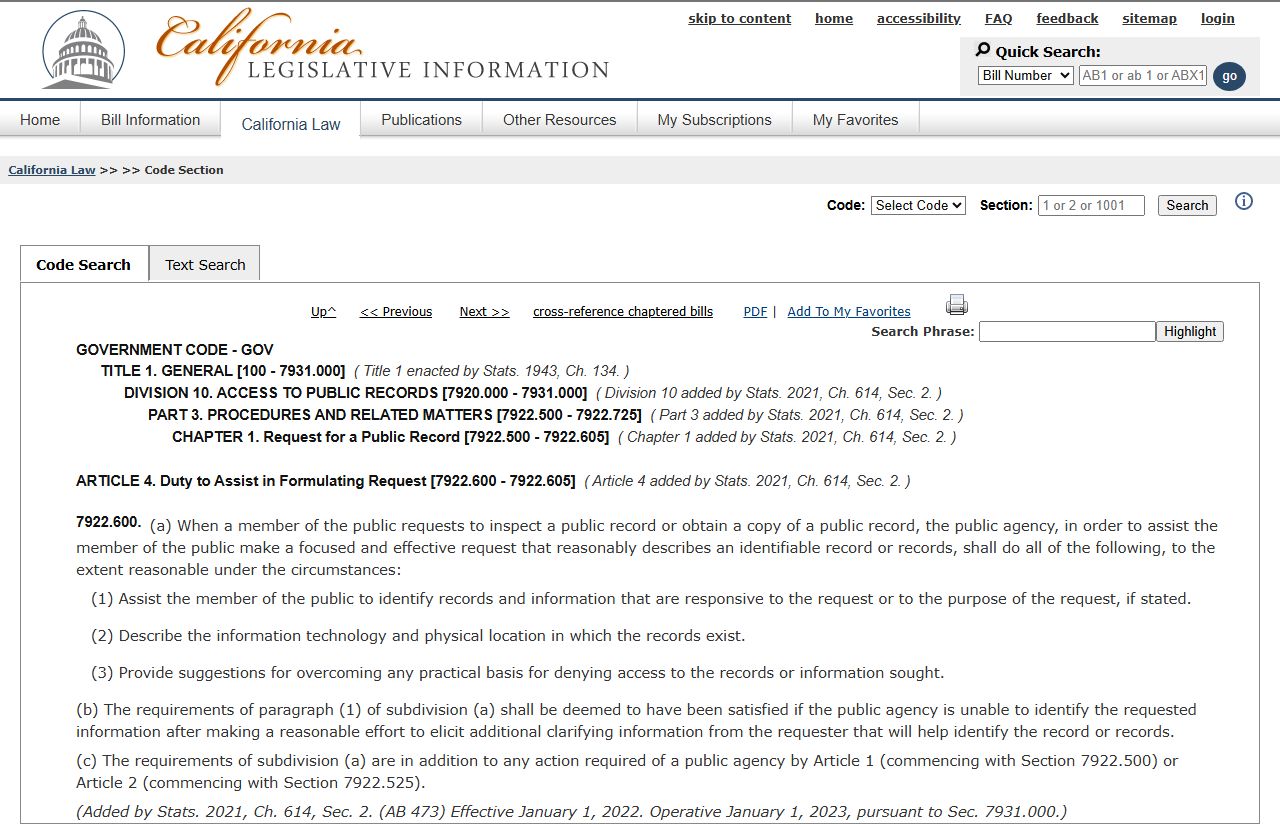 See the full text at Gov. Code § 7922.600. The duty to help shapes how staff handle a vague San Luis Obispo County public records search.
Clerk-Recorder San Luis Obispo County Public Records Form Fields
The Clerk-Recorder PRA form is short. Fill it in by hand or in a PDF reader. The table below lists each field on the form.
| Field | Required | Notes |
|---|---|---|
| Requester Name | Yes | Free text. Use a full legal name. |
| Mailing Address | Yes | Street, city, state, ZIP. Used for paper copies. |
| Phone / Email | Yes | Staff may call or write back for more facts. |
| Description of Records | Yes | Multiline. List names, dates, and file types. |
| Preferred Delivery Method | No | Check box: pick up, mail, or email. |
| Date and Signature | Yes | Sign and date at the bottom. |
Sheriff Records in San Luis Obispo County
The Sheriff Records Unit handles crime reports, incident reports, and traffic crash reports for unincorporated areas. Call (805) 781-4140. The Records and Warrants line is (805) 781-4588. There is no fee for a basic report copy. The unit aims to process most requests within 10 business days. Reports may be redacted. Some files are held back as law-enforcement investigatory records under Gov. Code § 7923.600. The screenshot below shows the text of that section. 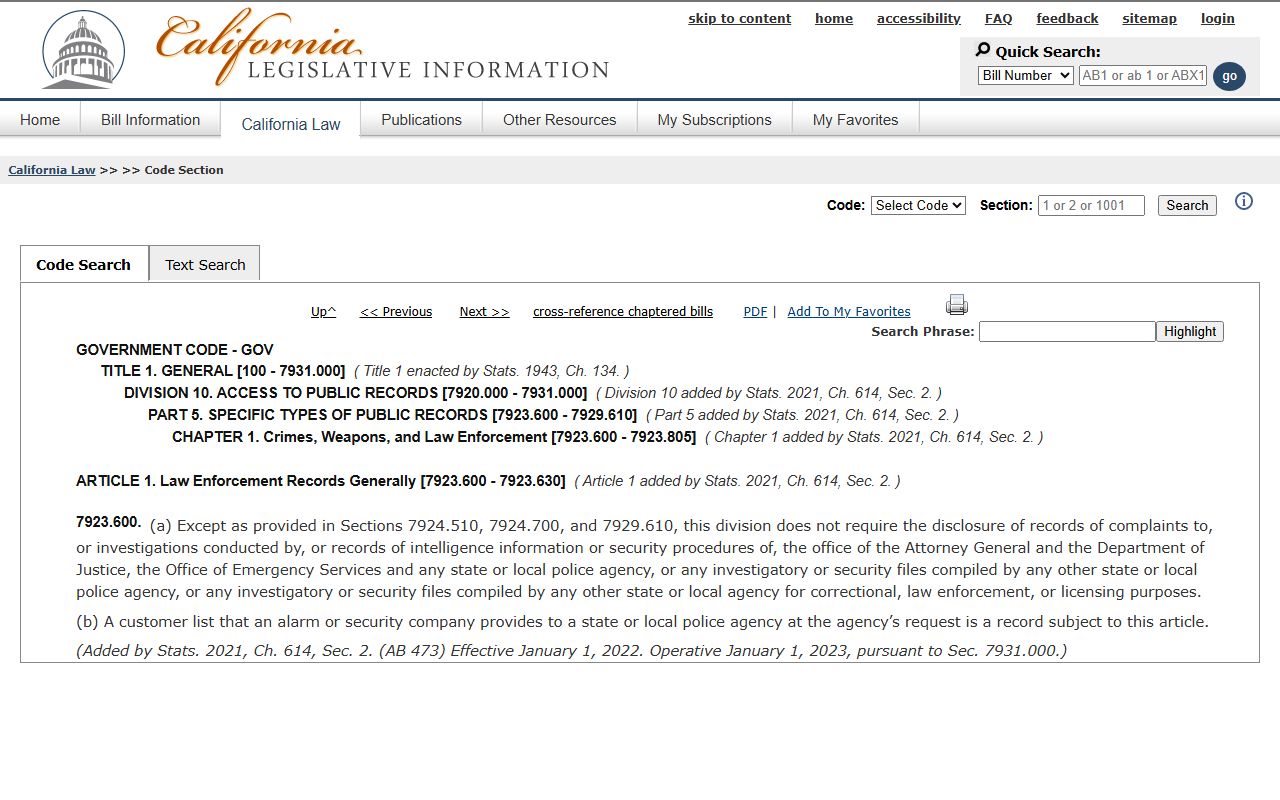 Source URL: Gov. Code § 7923.600.
For San Luis Obispo County DA case files, contact District Attorney Dan Dow's office at 1035 Palm Street, 4th Floor. Phone (805) 781-5800. For active cases, expect denial under the law enforcement exemption.
Court File Copies in San Luis Obispo County
Court case files are not San Luis Obispo County public records under the CPRA. They follow court rules. Get copies at the Superior Court, 1035 Palm Street, Room 385, San Luis Obispo, CA 93408. The court charges $0.50 per page. A $15 research fee applies if staff search more than 10 minutes (Gov. Code § 70627(c)). A certified copy costs $40 plus $0.50 per page for the copy itself. The Judicial Council self-help site has more on court fees and forms. Source URL: selfhelp.courts.ca.gov. The screenshot below shows the self-help homepage. 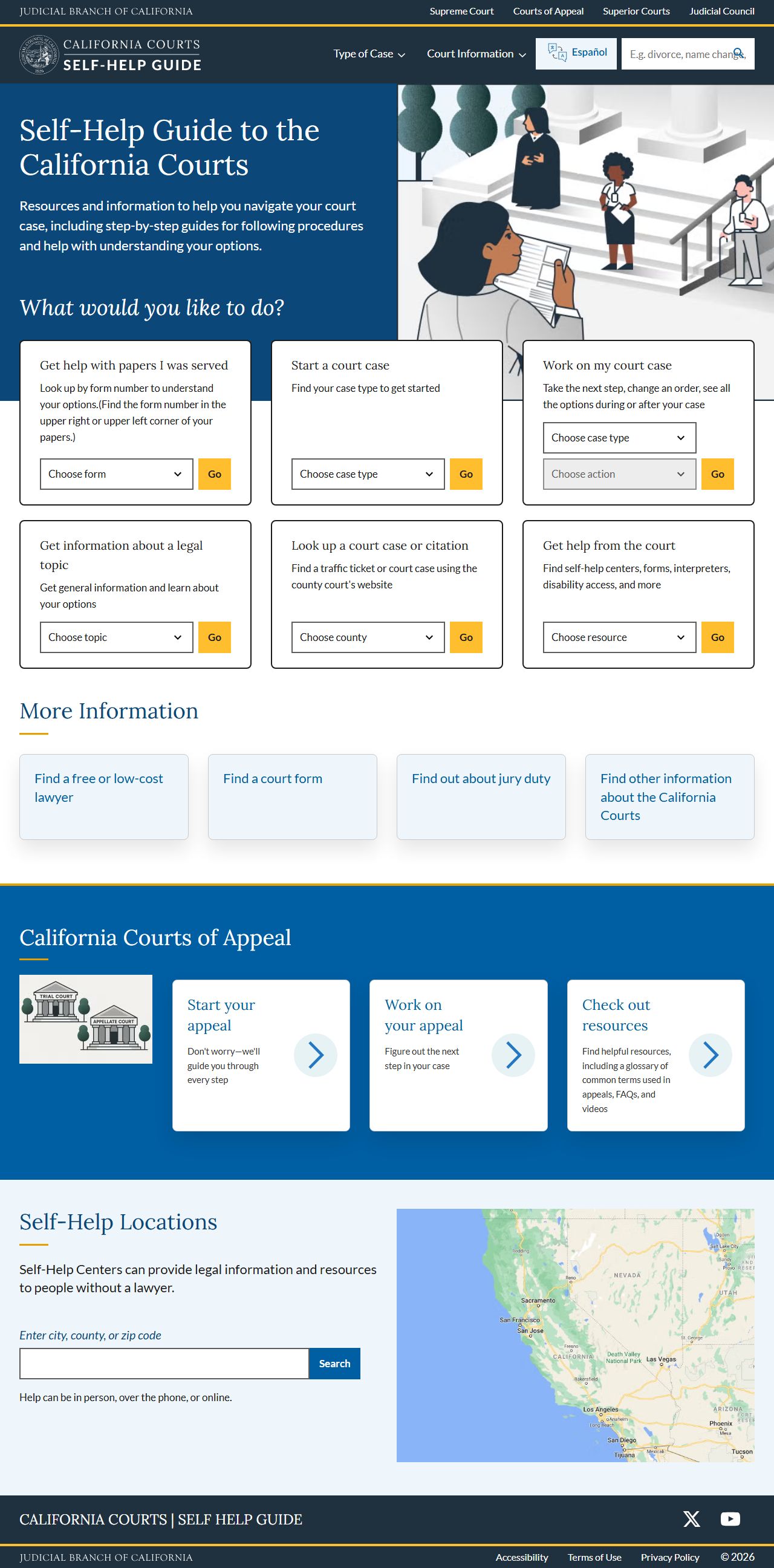 Use the search bar there to find a form. See also probate records and marriage and divorce records.
CPRA Exemptions in San Luis Obispo County Public Records
Some files are not open. The CPRA lists each class. The general balancing test sits at Gov. Code § 7922.000. The screenshot below shows the balancing rule text. 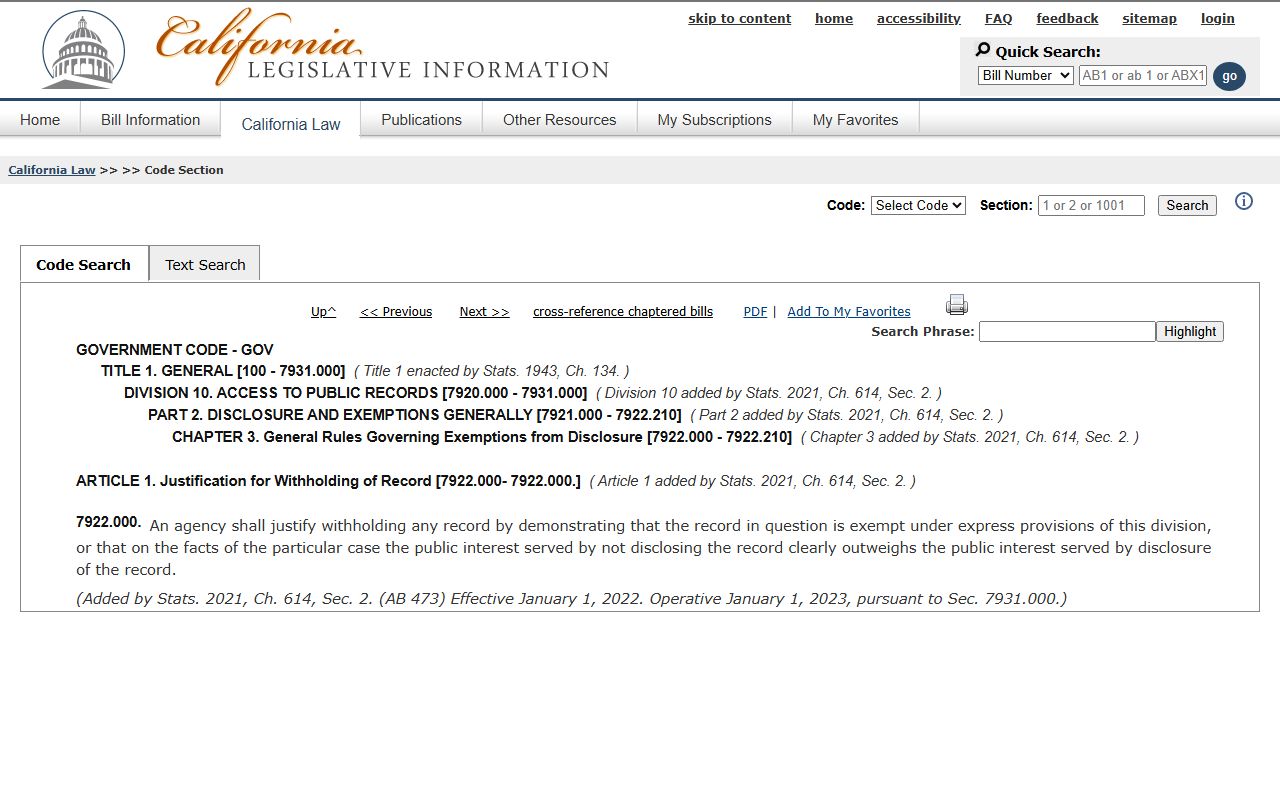 Read the full section at Gov. Code § 7922.000. The common San Luis Obispo County public records exemptions are below.
- Law-enforcement investigatory records (Gov. Code § 7923.600).
- Personnel files and medical files.
- Attorney-client and attorney work-product files.
- Drafts and pre-decisional notes.
- Security plans and building security data.
- Juvenile records.
- Sealed court records under CRC 2.550-2.551.
Sealed court files use a higher test. The court must find an overriding interest, a probable harm, and a narrow seal. See court records for more on sealed files.
Key CPRA Statutes for San Luis Obispo County Public Records
These four code sections drive most San Luis Obispo County public records work.
- Gov. Code § 7920.000. Sets the short title of the CPRA and starts Division 10 of the Government Code.
- Gov. Code § 7922.000. Sets the public-interest balancing test that lets an agency withhold a record only when the public good in keeping it secret clearly beats the public good in disclosure.
- Gov. Code § 7922.600. Sets the duty for an agency to help a requester find and frame a clear request.
- Gov. Code § 7923.600. Sets the law-enforcement investigatory records exemption used by the Sheriff and the DA.
Response Times and Fees in San Luis Obispo County Public Records
The agency must tell you within 10 days if the records are disclosable. The 10-day clock starts when the office gets the request. The office may extend the date by up to 14 more days when the request is large, when files are off site, or when staff must check the data with another office. The office must tell you in writing about the extension. The CPRA does not set a hard end date for the actual production. The office must produce the records in a prompt way.
Fees cover the cost of copies for routine work. There is no charge for staff search time on most CPRA requests. For files held in a database, the office may bill for the cost to program or extract the data. The Clerk-Recorder fee table sets the rates for recorded copies. The court fee chart sets the rates for court file copies. The table below gives a quick view.
| Item | Amount |
|---|---|
| Plain copy per page (court files) | $0.50 |
| Court research fee (over 10 minutes) | $15.00 |
| Certified court copy (plus per page) | $40.00 + $0.50/page |
| Sheriff incident report copy | No fee |
| Clerk-Recorder copy (per page) | See Clerk-Recorder fee schedule |
| Electronic format (data extraction) | Cost of programming or extraction |
Denial and Appeal Options
If a San Luis Obispo County office says no, ask for the reason in writing. The CPRA requires the agency to cite the code section it relies on. Read the denial. You may write back and narrow the request. You may also file a writ of mandate in the Superior Court. The court can order the office to hand over the records. A win on a writ can also bring an award of court costs and lawyer fees.
For smaller fights, try the office's own appeal route first. The Clerk-Recorder will reply to a written follow-up. The Sheriff's records desk will also do a second look. See our FAQ for common record questions. For probate and estate files, see probate records.