
What San Luis Obispo County Probate Covers
Probate is court work after a death. The court tracks down what the dead person owned, pays off taxes and debts, then sends what is left to the named heirs. San Luis Obispo County probate also covers trust disputes, will contests, and the lodging of wills. The court treats probate as a court-supervised process from start to close.
Guardianships and conservatorships live in the same calendar. A guardianship gives a person custody of a minor or the power to manage a minor's money. A conservatorship lets a judge appoint someone to care for an adult who cannot care for self or finances. All of it flows through the Civil and Family Law Branch at 1050 Monterey Street, Room 220.
San Luis Obispo does not run a stand-alone probate court. Probate is a division of the Superior Court of California, County of San Luis Obispo. The same clerks who handle civil cases also intake probate. Filers should ask for the probate window when they arrive.
Court staff post probate notes for each upcoming matter. These tentative rulings show how the judge is leaning on the case. Many uncontested matters move without a hearing once the notes go up and no one objects.
San Luis Obispo County Probate Terms
Probate files use words from old law. A short list helps before you read a petition or order. The terms below show up in most San Luis Obispo County probate dockets.
- Testator
- The person who made the will. The will speaks for the testator after death.
- Executor
- The person named in the will to carry it out. The court issues letters that confirm the role.
- Intestate
- Dying with no valid will. State law then picks who inherits.
- Beneficiary
- A person or group that takes a share of the estate or trust.
- Guardianship
- A court order that gives a responsible adult custody of a minor or power to manage a minor's property.
- Conservatorship
- A court order that puts a person or agency in charge of an adult who cannot handle daily care or money.
How to Search San Luis Obispo County Probate Records
The fastest start is the state's re:SearchCA portal at researchca.tylerhost.net. The court turned on public access there in January 2024. Court-side, tentative rulings and the probate calendar sit on the Probate Division page. For a deeper look, head to the clerk counter.
The court site below shows the probate landing page. It links the calendar, notes, fee chart, and FAQs in one place.
Source: slo.courts.ca.gov/divisions/probate
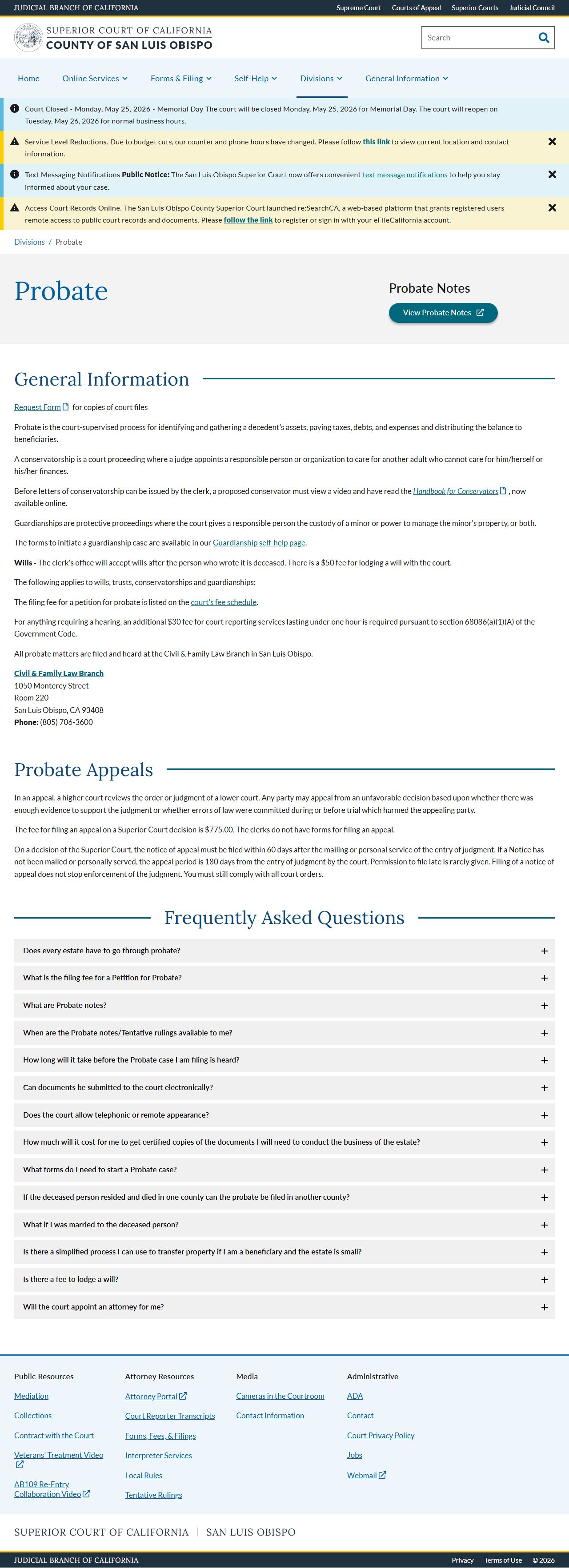
The court updates the first version of probate notes within a week of a hearing. The court then updates the day before the hearing in response to new filings.
- Open re:SearchCA and pick San Luis Obispo as the court.
- Choose case type as probate and enter a name or case number.
- Review the docket. If you need a stamped or certified copy, file a copy request with the clerk.
Need help with forms? The self-help team posts a probate page that links to California Courts' wills, estates, and probate guides. The shot below shows that resource hub.
Source: slo.courts.ca.gov/self-help/wills-estate-and-probate
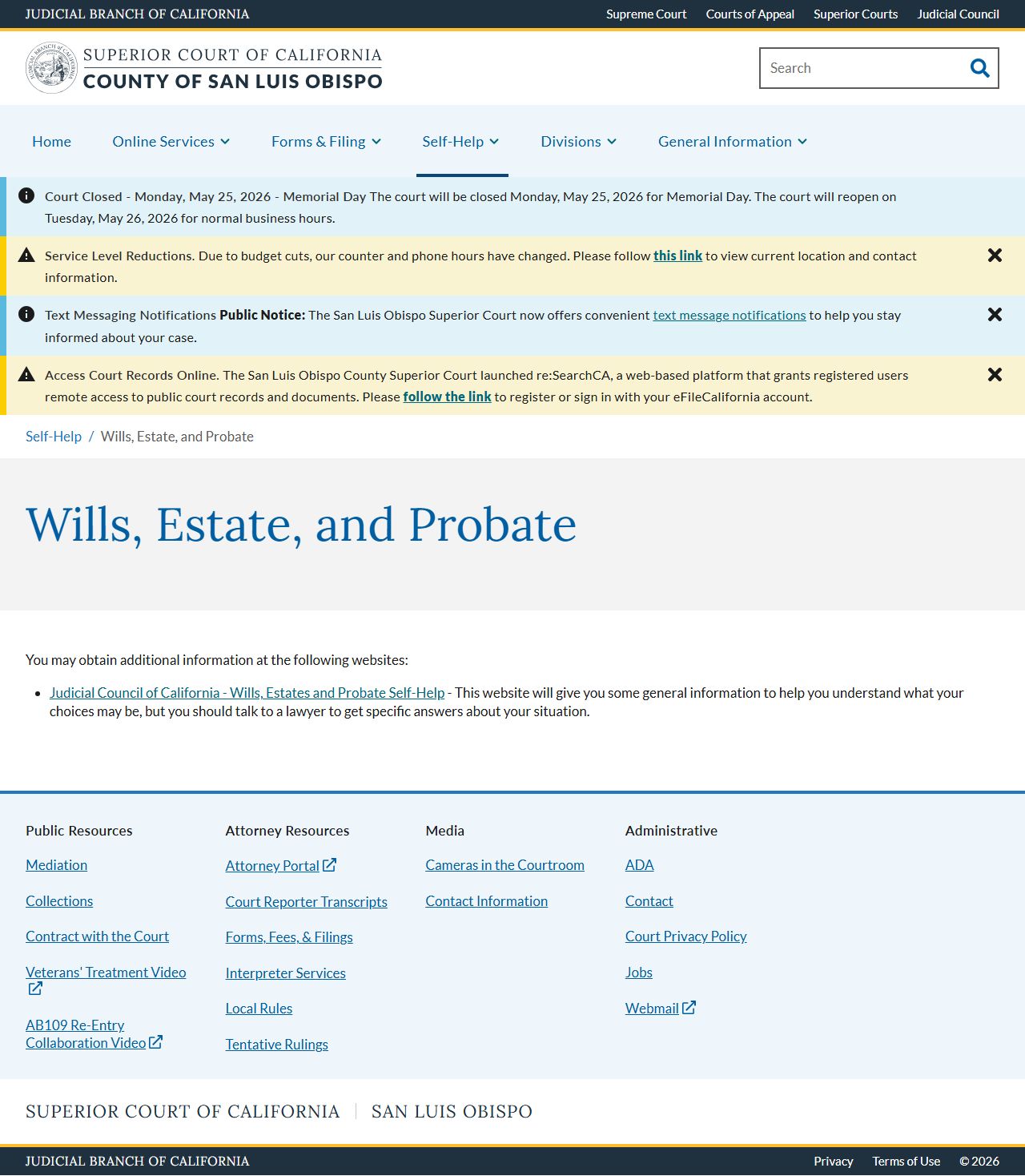
Self-help staff cannot give legal advice. They can show forms and point you to the right packet.
San Luis Obispo County Probate Court Contact
All probate filings land at one address. The same counter takes civil and family papers, so look for the probate sign.
Civil and Family Law Branch (Probate)
1050 Monterey Street, Room 220
San Luis Obispo, CA 93408
(805) 706-3600
Counter Mon-Thu 8:30 AM-12:00 PM
Phone hours run Monday through Friday from 8:30 AM to noon. After-hours filings can be dropped in the drop box at the front of the building. The court does not staff a separate probate phone line.
San Luis Obispo County Probate Fees
Probate fees in San Luis Obispo County follow the statewide chart with a few local items. Filing a petition costs the same as a response. The lodge-a-will fee only applies after the testator dies.
| Item | Amount |
|---|---|
| Petition for Probate | $435.00 |
| Objection or Response to Petition for Probate | $435.00 |
| Certain subsequent probate petitions | $435.00 |
| Lodge a will (after testator's death) | $50.00 |
| Probate appeal filing fee | $775.00 |
| Court reporter, hearings under one hour | $30.00 added |
| Certified probate copies | $40.00 plus $0.50 per page |
The court reporter add-on comes from Gov. Code § 68086(a)(1)(A). Fee waivers are open to filers who qualify under California Rule of Court 3.54. The clerk can hand out the waiver form at the counter.
San Luis Obispo County Probate Timing
New probate cases get set four to five weeks out. That window gives the petitioner time to publish the Notice of Probate in a local paper. Other judge requests usually get a hearing date ten to twelve weeks from the filing date.
Remote appearances are common. California Rule of Court 3.670 lets parties show up by phone or video in most uncontested probate matters when the judge has not ordered a personal appearance. The court posts Zoom links on the probate page.
Most probate papers can be filed online. The court accepts e-filing for almost every probate document type, with a few sealed items still done at the counter.
What San Luis Obispo County Probate Records Show
Every probate file holds a stack of papers built over the life of the case. Some are short, some run for years. The data below shows up in most San Luis Obispo County probate dockets.
- Case number.
- Estate, conservatorship, guardianship, or trust name.
- Petitioner.
- Decedent, conservatee, or minor.
- Filing date.
- Hearing date.
- Probate notes or tentative ruling.
- Petition type.
- Orders and letters.
- Inventory and appraisal.
- Notice publication and proof of service.
- Creditor claims.
- Final accounting and distribution.
The inventory and appraisal lists what the dead person owned. The final accounting shows how the estate paid bills and split the rest. Both papers are public for most decedent estates.
Small Estate Shortcut
Not every death needs a full probate case. The court FAQ says that if the dead person's property is worth $150,000 or less and the heir has the legal right to inherit, formal probate may not be needed. California changes that threshold from time to time, so check the current number on the California Courts self-help site before you file.
Heirs can use a small estate affidavit for many bank accounts and personal items. Real property has its own track. The FAQ page covers more on access for non-probate matters.
Restricted San Luis Obispo County Probate Files
Most probate paperwork is public. A few parts are not. Guardianship and conservatorship reports may be sealed in part to protect a minor or a person under care. Medical and mental health detail inside a conservatorship of the person is treated as confidential under HIPAA and the LPS Act.
Sealed records open only with a court order. The general rule is in CRC 2.550 and 2.551. To get inside a sealed file, you must file a motion to unseal or show a statutory right. Court staff cannot waive those rules.
San Luis Obispo County Probate Legal Help
The SLO County Bar Association runs a Lawyer Referral Service for paid help. The bar's homepage links the referral form and member directory.
Source: slobar.org
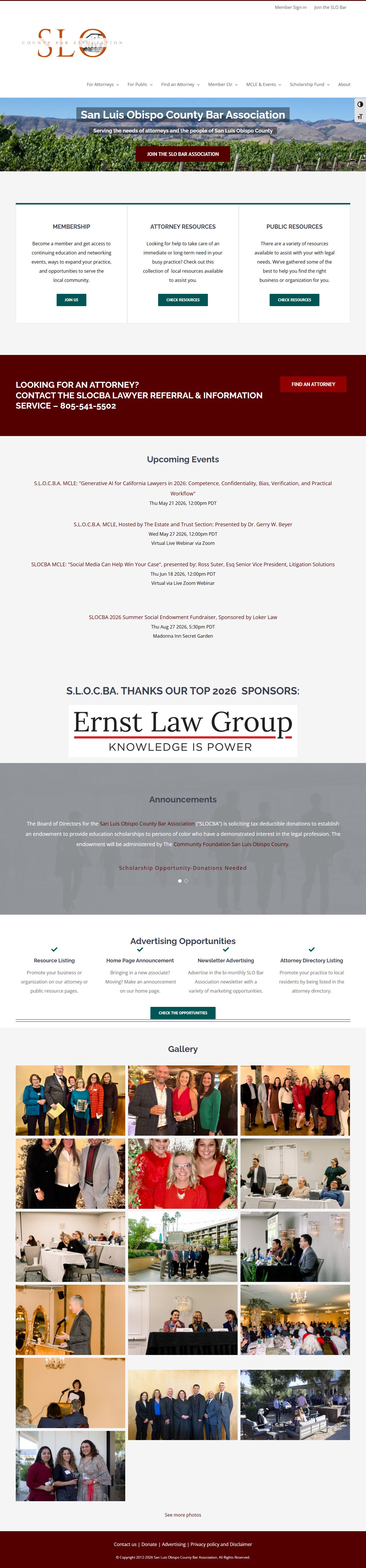
Pro bono and reduced-fee help is also out there for low-income heirs. Self-help staff at the courthouse can show you what to file but cannot fill it out for you.